Saturday, September 30, 2017

Contemporary Trend Shaping Education - Family Matters

The trend shaping education (OECD, 2016) that most resonated with me was Family Matters (pp. 19), with the following key points
  • Families are becoming reconstituted with single-parent families on the rise
  • Families are smaller or there is a conscious choice to not have children
  • Divorce rates are rising, yet marriage rates are declining
  • People are taking longer to get married
  • Our population is ageing
  • Household debt is rising
  • Impact of parental stress

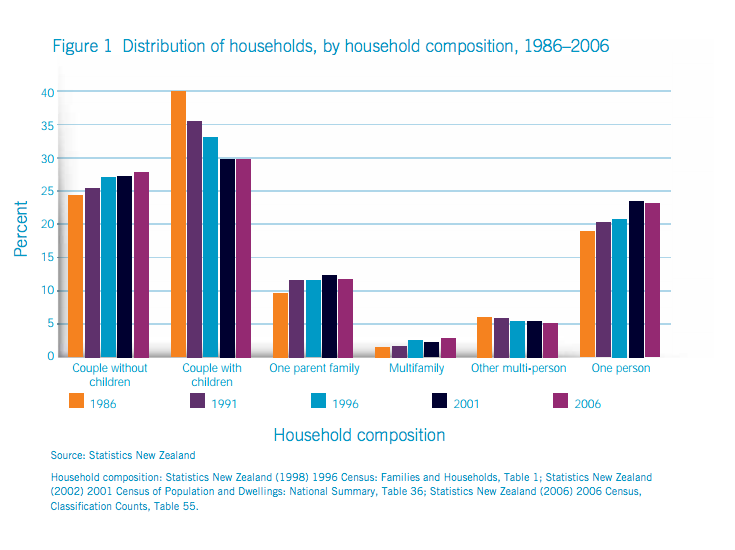
The previously dominant family type in New Zealand was the nuclear unit with a husband, wife, and children. There is now a diverse range of family types in NZ as shown by the New Zealand Families Today (July 2013, p. 3):

Screen Shot 2017-10-01 at 4.30.48 PM.png

How does this impact our education system?
I have chosen this trend as it directly impacts the education system. Families are the initial role model when it comes to values, culture, and traditions which in turn shape behaviour. It is important that we are inclusive and responsive to the growing demands within the family unit - be it grandparents raising grandchildren (9543 grandparents in a parental role - 2013 Census), or joint custody arrangements where time is shared between both parents. As more pressure is placed on families to meet their household demands (housing, nutrition, health, etc) there is also growing stress and mental health needs that impact on the education system through the children who are attending school. Children will struggle to learn and achieve if support is not available. However, conflict and frustration can arise as the rights and responsibilities of parents and schools becomes increasingly blurred as schools feel they are being expected to take on more responsibilities and the curriculum becomes more crowded. For example, “The case for teaching kids how to drive”. Schools are being asked to provide more but without the funding that supports this.

What does this mean for teaching practice?
We as teachers need to understand the nature and function of our families in order to make changes to our practice. We have noted that our changing family structures demand more inclusivity and responsiveness and PLD has been organised in response.  For example, Nathan Mikaere-Wallis. He discusses the importance of the family/environment and how we as teachers need to understand the impact of family dynamics so we are able to fully engage our children in learning and success. An extra effort needs to be made by schools in order to engage learners, family, and whānau so that positive trusting relationships are formed and partnerships built on with shared aspirations for children and learning. Through promoting acceptance of the many differing family structures we model tolerance and diversity so that all are included. Within our school, careful consideration is given to how we promote ‘Mother’s Day”, Father’s Day” etc so that children do not feel marginalised or excluded.

Consideration needs to be given to how best we can support families, especially those who are disadvantaged, without passing judgment or creating a feeling of intrusion - a tricky skill to master! However, by building positive, trusting relationships, open lines of communication can be initiated and grown and additional support discretely given. This, in particular, is an area that our school has continued to focus on as family structures and needs change within our community - parent/whanau engagement to support student learning and well-being, meeting the future needs of our society.


References:

OECD. (2016) Trends Shaping Education 2016. OECD Publishing, Paris. DOI: http://dx.doi.org/10.1787/trends_edu-2016-en

Statistics New Zealand (04 November 2014). Retrieved from
http://www.stats.govt.nz/Census/2013-census/profile-and-summary-reports/qstats-families-households/grandparents.aspx

Saturday, September 23, 2017

My Professional Context - Current Issues

Who we are?
Our school, located in the main service town on the Hauraki Plains is a full primary (Years 0-8), English medium school currently funded as a Decile 6 school. Our current roll is 299 students including 50 students who identify as Maori, 7 Pasifika and 5 Asian. As a school we have strived to raise levels of engagement and achievement, primarily through our 1 - 1 digital learning programme (BYOD) which was introduced in 2012, initially to Year 7 & 8, then expanded to include Years 4 - 6. This was the first of its kind on the Hauraki Plains.

What is the impact?
The consistent decile ranking of 6 has impacted on our school in a variety of ways. Staff and BoT use school-wide entry data, assessment data and current research available to help identify trends within the school and how best these can be resourced. The impact of lower socioeconomic status on educational achievement is well documented (APA, 2016; UNICEF, 2016; Snook & O’Neill, 2014; Thrupp, 2014) where what the child ‘brings to school’ is heavily influenced by their health, home environment, resources available and parent stress. Partly due to our Decile ranking of 6 and our minor urban area we have limited access to MoE schemes or initiatives that would support our student's educational achievement (E.g Fruit in schools), targeted funding for professional development and other support programmes in the school such as Sanitarium Breakfast Club and Eat my Lunch. The school’s BoT identifies this as a priority within the school and funds ongoing professional learning programmes for staff, additional learning support in-class and discretionary funds for those who need support. There is a strong focus on building a school culture and learning environment that is both responsive and inclusive. As part of the ongoing professional development, the school is enthusiastic about investigating further, the work of Nathan Mikaere-Wallace.

NPS School Culture
The first impressions of a school can heavily influence any prospective parents/whanau choice in where they choose to enrol their children. This is known as the school culture - not only the values and beliefs of that school but how they act and react in different situations. Stoll (1998) refers to culture as “situationally unique” and what may work in one school may not necessarily work well in another school. The school needs to be clear in its reason for being, what sets it apart and where it is heading.

Ngatea Primary School (NPS) is very aware and mindful of the impact culture has. We constantly revisit what it is to be part of NPS; our values and goals, how we can achieve more (professional development, student outcomes, engagement with our community and beyond), support to take risks, the why and where to next. All of which are included in what Stoll and Fink (cited in Stoll, 1998) identify as cultural norms that influence school improvement.
An area that staff have identified as needing more focus is celebration, at times we are so intent on the next steps that we neglect celebrating what we (teachers and students) have achieved!

All of the above are built on the positive and meaningful relationships we have with each other as teachers, with our students and whanau and the wider community. If these are strained or lacking the result is mixed messages and a feeling of ‘going through the motions’.

References:
Snook, I. & O’Neill, J. (2014). Poverty and inequality of educational achievement. In Carpenter, V., Osborne, S. (Eds.), Twelve thousand hours: Education and poverty in Aotearoa New Zealand (pp. 19-43).  Auckland, New Zealand: Dunmore Publishing.
Stoll. (1998). School Culture. School Improvement Network’s Bulletin 9. Institute of Education, University of London. Retrieved from http://www.educationalleaders.govt.nz/Culture/Understanding-school-cultures/School-Culture
Thupp, M. (2014). Deficit thinking and the politics of blame. In Carpenter, V., Osborne, S. (Eds.), Twelve thousand hours: Education and poverty in Aotearoa New Zealand (pp. 88-101).  Auckland, New Zealand: Dunmore Publishing.
UNICEF. (2016). Child poverty in New Zealand. Retrieved from

https://www.unicef.org.nz/learn/our-work-in-new-zealand/Child-Poverty-in-New-Zealand

Saturday, September 16, 2017

My Community of Practice

Whenua Teaching Team

I am part of the dynamic duo who teach and learn in an ILE/MLE where we consider ourselves ‘Authors of our own learning - in a collaborative and supportive community that lets play, passion and purpose grow’. Our Whenua learning team is made up of two teachers, 56 learners, and two learning support ladies. My role as team leader provides opportunities for me to not only lead but follow where the strengths of those whom I work with are built upon and shared with others. There is a strong culture of support and sharing of ideas, reading and research within our team. Opfer & Pedder, 2011) refer to this as a micro-learning community of practice that is achieved through an open modern learning environment.

School Community

Over the last 7 years we as a school have been on a journey where we have constantly critiqued, questioned and researched what we as teachers are doing for our learners. “What is collaboration and how do we learn together?” “What’s going on for our learners?” “How do we know?” “Why does it matter?”. This enables us as a staff to inquire into the latest research and published material, focusing on what may be beneficial for our school (staff, students and whanau). Within our school there are people (teaching staff, support and administrative) who have areas of expertise or passion who also mentor and support ongoing reflection and change. Our deputy Principal has led the school through a rigorous self reflection process with a focus on Dumont, Istance & Benavides ‘The Nature of Learning - using research to inspire practice’ (2010) and Timperley, Kaser & Halbert “A framework for transforming learning in schools: Innovation and the spiral of inquiry (2014) as a framework to lead change. Our BOT provides the financial assistance and investment to enable us to stay current in research.


Kāhui Ako - Hauraki CoL

We belong to the Hauraki CoL where information/data is shared and achievement challenges are shaped in response to the baseline data collected. These include surveys (NZCER Teaching and Leadership Practices Survey, NZCER Me and My School Survey) and student assessment data (e-asTTle, PAT). There has been a focus on improving practice with particular attention paid to writing outcomes. Support and guidance are provided by outside agencies to develop a shared understanding of effectiveness capabilities, current learning and teaching practices and engaging community.


Virtual Communities
There has been a rapid increase in accessing and using online tools and communities to broaden my teaching knowledge and practice. I belong a variety of online communities such as Facebook (e.g. NZ Primary Educators PLN, NZ Teachers (Primary), Te Reo Maori (Mainstream NZ Primary) to name a few. Google+ communities include Mindlab, Hauraki CoL as well as VLN, Twitter and LinkedIn. All of these provide a platform for discussion, critical reflection, support and research that can be utilised in my learning environment to best meet the needs of myself as an educator and my students. I am able to access people and resources I have not been able to do previously - a truly global community of practice.


References:
Dumont, H., Istance, B., & Benavides, F. (2012). The nature of learning. Using Research to Inspire Practice. Practitioner Guide from the Innovative Learning Environments Project. OECD. Zugriff 7, 2014.


Opfer, V., & Pedder, D. (2011). Conceptualising teacher professional learning. Review of Educational Research, 81(3), 376-407.

Timperley, H., Kaser, L., and Halbert, J. (2014, April). A framework for transforming learning in schools: Innovation and the spiral of inquiry. Centre for Strategic Education, Seminar Series Paper No. 234.

Friday, April 28, 2017

It's been a long time between posts!

A lot has happened since 2015 when I last posted. I was lucky enough to have been awarded a year's study leave to complete my Bachelor of Teaching at Waikato University.  It was with much trepidation that I embarked on that journey as my experiences at uni were not that enjoyable the first time around (try the late 80s). My fears were unjustified this time around - I met an amazing group of student teachers completing their third year at uni who helped and encouraged me along the way. The connections made added to my overall experience and the schools that have employed these enthusiastic young people should be very pleased with themselves.

I loved learning - the readings, discussions and even the odd assignment!

Suffice to say, I completed my papers and graduated in November 2016!


Saturday, October 17, 2015

uLearn15

I was lucky enough to be able to go to uLearn15 in Auckland these past holidays.
Our opening keynote speaker on DAY 1 was Grant Lichtman, who was very easy to listen to. Ideas that resonated with me were the following:

Asking learners -
  • What is the one word you can use to describe your day today?
  • What does innovation mean to you?
  • What obstacles did you face?
  • What were your successes today?

You cannot innovate without taking risks and is it really hard or is it uncomfortable? Being  honest with yourself is one of the challenges. Building capacity to make change is linked to mindset - What if?

Breakout 1:
Teaching with Thinking Dispositions with Karen Boyes.
Karen’s presentation was entertaining and thought provoking, with narratives about her children and experiences, making it easy for her audience to connect.
One of our biggest challenges in today’s classrooms is around change - do we
  • Create it?
  • Embrace it?
  • Fight it?
  • Ignore it?
and what do our learners do when they don’t know what to do? This is true of adults as well!

Learned helplessness is evident in today’s society with ‘Helicopter parents’ (those who hover around their children making sure everything  is ok) and my favourite, ‘Lawnmower parents’ (they clear the way for their darlings so nothing can go wrong!). Adults are too quick to jump in and rescue students - they need to experience what it is like to struggle, solve problems and make good. This slide from Karen’s presentation says it all -
We need to allow learners to be bored...restrict access to resources, cut tech. time, and have time where there is no agenda at all. This allows room for learning to occur and strategies to grow.

Breakout 2:
Project Based Learning with Sarah Wakeford (HPSS)
I have listened to Sarah before at the EdChat conference last year and was keen to see how Project Based Learning had developed at HPSS. She did not disappoint - full of energy and great ideas that she was passionate about sharing.
Key points:
  • The need for an authentic partnership (outside the learning environment strongly recommended)
  • Having a clear process - Kick Off, Plan, Action, Showtime, Final Look

From Hobsonville Point Secondary School

  • Criteria - one trip ‘out’, one ‘expert’ in
  • Use of a rubric as a point of self assessment
  • Time to reflect at each stage of the process
  • Blogging - using specific vocabulary, sharing the process, reflecting, etc

DAY 2
Our opening keynote speaker was Dr Anne Lieberman who presented her findings around teacher leadership.
Teacher Leadership - what do we know so far?
Shift - what do we know about learning and how do we accommodate the changes
Teachers are great storytellers, need to show evidence
Schon - reflective practice
Wenger - ‘communities of practice’

Learning as:
  • social participation
  • discovering meaning
  • identity
  • (in) community

Breakout 3:
Enhancing Thoughtful Classroom Dialogue with Karen Boyes
As I had listened to Karen the day before I was curious about how different this breakout would be compared to the previous day - I needn’t have worried. Once again Karen was extremely easy to listen to and connect with as she spoke of ‘real’ happenings.
She discussed 6 key areas of developing dialogue and I found it interesting to reflect on my own practice as to how I have tried developing meaningful dialogue in my learning environment.

Classroom Environment
  • The need to understand the brain, how it functions, the emotions that are intrinsically linked.
  • Higher order thinking happens in the frontal lobe and the brain is ready for this at around 7 years of age.
  • The importance of oral language! Panic causes the brain to ‘shift’ down in thinking.
  • Music lifts a room, lessens the risk level.
  • The need to value everyone's participation and eliminate judgement.

Teacher Technique
  • Power of STOP, WAIT, THINK - to manage impulsivity.
  • Wait time/think time (7-10 seconds) to allow processing.
  • Think - Pair - Share
  • Coming up with ways to lower the risk.

Listening Skills
  • Makes the biggest difference to success
  • Pause - wait time
  • Paraphrase - opportunity to say something to show you are on the same page
  • Probe - increase clarity, asking questions, depth
  • Inquiring into how do you listen?

Power of Language
  • What are some of your ideas?
  • Clarity - precision
  • Language and thinking are intertwined
  • Thinking verbs

Thinking About Your Thinking
  • Metacognition - being conscious and aware
  • Think aloud problem solving
  • If you don’t think about your thinking, how do you make a change?

Questioning
  • Awareness of unproductive questions
  • Intentional questions - approachable, friendly tone
  • Invitation stems “What are some of your goals?”  “What might be some…”  “In what other ways could you…”   “I know you don’t know but if you did know…”
  • Invitational “As you…”   “Given what you know about…”   
  • Empowering “What are some of your goals?”

Breakout 4:
Fostering Individual Learning Capacity with Andrea O’Hagan
I was not sure what I was in for in this breakout as Andrea was very softly spoken and began by talking about drama! We were a small group of primary teachers from all kinds of backgrounds but with similar wants from this breakout - making connections with those learners who continue to defy our approaches.
Andrea stressed the effectiveness of language patterns which supported what Karen Boyes had also talked about in her presentation! I knew I was in the right place.

  • Being aware that particular language patterns can lead to resistance and fight/flight is ignited.
  • Have to communicate clearly so there is understanding.
  • Preferred way of expressing our inner world - Visual, kinesthetic, auditory.

  • Change predicates so it makes sense (E.g. moving from a visual pattern to their preferred language pattern).
  • Listen to self (radio is a very good way to do this, to identify language patterns).
  • Try to include all 3 language patterns when speaking to learners.
  • Probability modal operator - “You could...couldn’t you”   “You might...mightn’t you”   “Maybe you will find this easier than you thought it would be”  “Let me tell you what you have to do”
  • Reflective listening - this verbal ‘mirror’ allowing a person to hear their own thoughts again out loud.
  • How can I change my choice of words so that I am neutral?
  • How can I present myself to the learner so they are not threatened?
  • Using curious in a sentence engages “I’m really curious to see how quickly you will make a difference to your learning?”
  • Adding ...not yet! (NPS Learning Powers)

DAY 3
Breakout 5:
Leading Change Leadership with Mark Osborne
Mark is a great presenter who is very approachable, is able to connect with his audience and motivate change whether it is in small tentative steps or in ‘man sized’ strides!
Key ideas:
  • Values and beliefs - we know why we are doing things
  • Purpose and ability to answer the questions
  • Relational trust
  • Management - procedures, systems etc, capturing and using institutional knowledge
  • Leadership - produces change, going somewhere new
  • Knowing self - strengths/weaknesses
  • Connected, empowered teams, networks, complex, pooling information - making decisions together.
  • Adaptive capacity - ability to cope with change!

Readiness for change
  • That change is needed!
  • Establishing a sense of urgency “What is our burning platform?”
  • Proposed change is appropriate for the challenge at hand
  • The organisation has the capacity to implement the change.

Supporting people through change
  • Need to honour people and their perspectives
  • First order change - tweak, minimal, ‘change’ is incremental
  • Second order change - disruptive, learn new, emotional
  • If you think mana/identity will be lost = resistance
  • Questioning self ‘conscious incompetence’ Heifetz
  • First order change may be second order change for people
  • Have to acknowledge loss - time to grieve
  • Honour everyone’s experiences

Finding opportunities for people to mentor, guide using their curriculum knowledge (using strengths)
Systems to timeline change, prioritise, identify steps.
We all need to be pushed out of our comfort zone but EVERYTHING changing can be disruptive.

Breakout 6:
Lead with Meaning with Barbara Cavanagh & Miranda Makin (ASH)
These two ladies had definite opinions and ideas about what leading in education looks like both in their school - Albany Senior High, and what could be achieved in other schools if we are serious about leading and making a difference in education.
Key ideas:
  • You can choose to be a leader or a maintainer.
  • Old solutions are damaging in new times.
  • Things have changed dramatically  - “How do kids learn?”  “How do we create an environment where every student succeeds?”
  • Children are very different to each other - one size does not fit all!
  • Need to be sure we sabotage the system and follow what research says (e.g. exams)
  • Work with constraints to make sure children succeed.
  • “Not if you are bright, it’s how you are bright!”
  • How do we help teachers in their quest for quality?
  • Teaching as inquiry allows us to meet each child’s needs.
  • Practice decisions = increases outcomes

Teachers motivation for teacher inquiry is
  • student outcomes + assessment
  • to make a difference for those students that are in crisis
  • to name those students in crisis - be accountable
  • exploring theories of what might be, offers up opportunity around beliefs
  • exposing our theories and searching for new possibilities
  • to understand the problem that you are trying to solve in different ways - include the students!

Creating space for teacher and leader learning
  • Challenging beliefs is important for learning as well as maintaining a positive working relationship.
Sharing control
Increasing validity for information to base decisions from
Increasing mutual respect

  • How do you maintain your dignity as well as the other person’s dignity while making change and having difficult conversations?
  • There is a responsibility to be a leader
  • Stop making assumptions about students
  • Being transparent creates relational trust.


The experience of going to uLearn15 and hearing from leaders in education has contributed to my inquiry into my teaching practice as both a classroom teacher and as a leader within our school. I highly recommend attending uLearn16 which will be held in Rotorua next year.