Sunday, July 8, 2018

Poutama Pounamu Online - Module 3

Cultural Relationships for Responsive Pedagogy - Reflection

This module has reinforced everything I have been exploring in other areas of my practice.

Everything is coming together across the different professional learning I am currently
undertaking - Te Wānanga o Aotearoa He Papa Tikanga, having the opportunity to listen
to powerful speakers such as Hoana Pearson, read confrontational material such as
“Colouring in the White Spaces” by Anne Milne and participation in the CORE Education Empower programme Te Whakamānawa Culturally Responsive Practice in School Communities from Term 3.


The message that comes through is a strong need for a deeper understanding of what has come before (colonisation of Aotearoa), being responsive to our learner's prior knowledge and experiences so we can build whanaungatanga. The roles of ako are fluid, and it is important to add value not dilute as we move forward in learning - adding to the kete, not taking out. Underpinning this is the responsibility that we never assume that just because a learner is Māori, that they know what to do or have the knowledge of all things Māori.


The following is my reflection from Module 3:

Why did I give that answer?

We have different experiences that can be shared in an environment that is 
non-judgmental and supportive. It does get uncomfortable at times, but we respect what the other has to say. Our Kaiwhakaako will challenge our ideas and thinking but does not belittle or make us feel inadequate. I enjoy the discussions we have immensely as they make me reflect and think beyond what I know.


What are two key ideas you are taking from this activity?

My first idea is…
To continue to ask for help and support to improve my own understanding and practice of
developing cultural relationships for responsive pedagogy.

My second idea is…
To challenge and question other within our staff to look deeper into our own school’s
(and their own) understanding and practice about developing cultural relationships for
responsive pedagogy. As a staff, we started this journey last year but I feel it has fallen
away. Hopefully undertaking the CORE Education Empower programme Te Whakamānawa Culturally Responsive Practice in School Communities from Term 3 will provoke further critical reflection, discussion and exploration as a staff and school.

What actions do I and others intend to undertake as a result?

As a collaborative team, we critically reflect on our classroom practice and programme 
on where to next in term 3 and beyond.

Take a more active role in supporting staff on their continuing journey, beginning with 
the CORE Education Empower programme Te Whakamānawa Culturally Responsive Practice in School Communities. Asking the questions that need to be asked - it will be uncomfortable at times but this needs to happen so others begin to look more closely 
at the ‘white spaces’ playing a part in their practice.

I don’t have all the answers (if any!) but I can help facilitate the peeling back the layers of doubt, show honesty in my own practice and a willingness to learn more.

Monday, June 18, 2018

Equitable Education For All


This will take courage, commitment and care!

As a teacher in a New Zealand/Aotearoa classroom, I am fully aware of the need to be
culturally responsive and inclusive in my teaching practice - as Janelle Riki-Waaka pointed
out “How will I know that this is a classroom in NZ?” That reignited the drive for me to know
and understand my Māori learners, and what success and achievement looked like for them
as Maori. Most of the literature and learning I have undertaken had been focused on the
need to deepen my understanding of what has come before - the colonisation of Aotearoa
and the impact this has had on Māori, successive systemic practices and policies all
determined by the dominant culture (institutional racism). As educators, we need to be
responsive to our learners' prior knowledge and experiences so we can develop a collective
partnership to raise outcomes for Māori learners (Poutama Pounamu, University of Waikato).


Much has been written and researched about racial and cultural bias in education and its
impact on our Māori learners. The message coming through strongly in what I have read
is the necessity to recognise our own unconscious bias/prejudice and how this influences
our teaching practice. Critically examining my own unconscious prejudice and assumptions
have been painful and revealing. In “Colouring in the White Spaces” (2017), Anne Milne
uses powerful language and pulls no punches about what is happening in education, forcing
one to sit up and critically examine what and how we think, especially from a position of white
privilege. When you are a white, middle-aged woman and only now realising that you display
unconscious prejudices, reading Milne’s book, listening to Hoana Pearson speak and taking
part in frank discussions, this forces you to critically examine and rethink classroom practice
(and how I respond in society). It takes courage to step outside of the dominant and powerful
culture that is pākehā - recognising that white spaces are spaces “that reinforce stereotypes
and negative ideas about Māori” (Milne, 2017, p.5).


Where do I start?
I have reflected on my journey so far but have a way to go so identifying where I sit on the
action continuum - eliminating White spaces (Ann Milne) is a way of checking where I am at.


From Dr Ann Milne; Colouring in the White Spaces: Reclaiming Cultural Identity in Whitestream Schools. Presentation at ULearn 2017


At present I feel that I am sitting at the purple level, leaning towards the green - ‘some
language and cultural content...but still colonial in terms of expectations, definitions of success”.
I am only a third of the way through “Coloring in the White Spaces” so no doubt there will be
much more to come.


What next?
When reading “Healing Our History” (2001), Consedine says “change only occurs when you
allow yourself to be what you are, instead of trying to be what you’d like to be” (Consedine &
Consedine, 2001, p. 159). This is supported by Hoana Pearson (2018) when she said that in
order to know and understand others you need to know and understand yourself. By actively
exploring the intended meaning of Te Tiriti o Waitangi is, the implications and how this has
shaped where we are today, we will be able to move forward. I need to do this in a way that
retains my own authenticity and identity. It is not about blame or guilt (easy to say I know) but
acknowledging the mistakes of the past and having the courage, commitment and care to
make a difference from now.


I feel that Hoana Pearson’s “The Courage to Relate - The Essential Ingredients” is a
structure that will support me on my continued journey.


From Hoana Pearson; Outline of MAC's and what works.
Presentation at Waikato Principal’s Association Connections Day, 2018


I have so much more learning to do!


References:


Consedine, B. & Consedine, J. (2012). Healing our history: the challenge of the Treaty of Waitangi
(2nd ed.). New Zealand: Penguin
Cultural relationships for responsive pedagogy...builds on Māori metaphors [Brochure]. (n.d.).
Tauranga, New Zealand: The University of Waikato.


Milne, Dr. A. Colouring in the White Spaces: Reclaiming Cultural Identity in Whitestream Schools
[Video file]. (n.d.). Retrieved from https://www.youtube.com/watch?v=5cTvi5qxqp4


Milne, Dr. A. (2017). Coloring in the White Spaces. New York, United States of America:
Peter Lang Publishing.

Pearson, H. (2018). Outline of MAC's and what works. Presentation, Hamilton, New Zealand.

Sunday, May 20, 2018

Poutama Pounamu Online - Module 2

Culture, Language and Identity - Reflection
I found this module particularly challenging - as it highlighted my lack of deep understanding of the Ka Hikitia document. Yes, I knew about it, had seen it but never really dug into it, in fact, I found that I was embarrassed.

So many thoughts were coursing through my mind, tumbling over one another - there is conflict in what I know (or don’t know) with what I think I want to do and the questions that arise from looking into oneself. How do I develop my knowledge and understanding further and what is the impact of this, both on my personal growth and growth as a professional educator? How do I open the door for others to take a leadership role when I am just a female pākeha woman? I know I need to do more but how do I negotiate the minefield that comes with it? Where I thought of empowering people to lead, can it be construed as “sharing a position of power” therefore reinforcing the idea that I am coming from a place of power??


After viewing Sir Mason Durie speak; He Korowai Oranga - Māori Health Strategy launch from 2014 my conflicting thoughts around how to understand different perspectives without offending someone was somewhat appeased. Yes, we are able to hold views simultaneously, changing to and, not or. We need to judge the situation in context as to the best approach and acknowledge the beliefs held. For example, Mauri - the life force or life essence of a person or being. “A person who is ‘Mauri Ora’ is one who is healthy in wairua (spirit), hinengaro  (mind), and tinana (body)” (Te Wananga o Aotearoa, n.d., p. 8). Is there only one way (medical) to heal a person? Who are we to dismiss one belief over another?

I feel like there are so many more questions than answers at the moment...


Why did I give that answer:
I enjoy having the opportunity to sit and discuss what we have viewed and listened to without a fear of being judged. It has certainly proved thought-provoking as my ideas, thoughts and wonderings have been challenged (not as a criticism but as a way of deepening my understanding). Each of us has brought their own lens to the conversation, at times they may be similar and others, not). It was reassuring to realise that one can hold different views simultaneously, judging a situation in context and the beliefs present. This has lead me to probe deeper  - what are my understandings and beliefs and how do they affect my ability to be a leader, or even if I want the role?


What are two key ideas you are taking from this activity?
My first idea is…
Complete the second kīte from He Papa Tikanga; Te Ao Mārama - The World of Understanding (Te Wānanga o Aotearoa as this course is supporting my growing understanding of The Māori World and key concepts in Māori culture.

My second idea is…
To continue to challenge what we do and why we do it, beginning with my learning team - Whenua (teachers and students) and provide provocation to other staff members to question further their understandings. I would do this through questioning and sharing of resources (Ka Hikitia, Poutama Pounamu videos/links around student voice, Ako: Critical Context for Change).


Sunday, May 13, 2018

Term 2 Week 2 Reflection

Inquiry Through Play

One of the goals that I selected as a next step was to have a deeper understanding of the what the Pre-Operational Cognitive Stage through to the Concrete Operational Cognitive Stage in development is and where our learners sit within this continuum. Is this learner developmentally ready for what I am trying to do?

This has quite an impact on what I am trying to achieve in Whenua. I no longer try and push the learner into learning that they are not developmentally ready for - that it is ok to meet them where they are at present and respond to their current needs. This has led to a higher level of engagement from the learners (for example, J, F, E) and they are smiling and actively joining in what is on offer. - even continuing with the activities at home! There was one small group that threw a ball around each session (A, L, J), and at first, I was unsure of how to respond or encourage them to explore other areas of play. Then I realised that this was their ‘safe’ option and that they were not developmentally ready for anything else at that point- so I left them to it, working on the idea that they would tire of this and see what others were doing. By the fourth day, they had indeed moved on and were investigating insects, their homes and how they could design a suitable home!

A second goal was to get to know the NZ Curriculum inside and out, making links to what the learners are doing in their play and the AOs - using documented observation to inform next planning/response to play, planning for areas that do not naturally arise and how to inject knowledge (throwing the hook out and seeing who takes the bait - or not!). What a pleasure it has been to delve back into this amazing document. Armed with my notebook and iPad (for photos) I have observed what is happening, asked questions and dropped morsels into the conversation and walked away. From our observations we have set up provocations and invitations - some have been ignored but we are not concerned as we will offer them again at another time. The more we link what we observe with the NZC the more skilled we become. My aim is that in our Team Meetings we will share a photo we have taken and then map it back to the Curriculum. The example below is from the Nitty Gritty workshop I attended facilitated by Longworth Education at Takanini School in April. Our group brainstormed the links to the NZC. This is an example of what I would like to do in Team Talks.


From “The Nitty Gritty Workshop” Longworth Education, April 2018


Pounamu Poutama (further reading)
I have started reading "Healing Our History, The Challenge of the Treaty of Waitangi" by Robert Consedine and Joanna Consedine. All I can say is that this book needs to be a must read for educators - as it provides background to the struggle and conflict Māori continue to experience in Aotearoa and the part ‘Colonisation’ has played and continues to play in this.

Pause, Breathe Smile
We had our first session of Pause, Breathe and Smile with Tracey and Laura. Our Learners were asked to complete a self-awareness activity where they had to place themselves on a tree (see below) of how they felt about mindfulness and their response to it.


Interestingly there was a small group who placed themselves in ‘free fall’. They are a group we had already noted did not involve themselves in our Mindfulness programme showing disinterest, preferring to annoy others and fidget. We will repeat the activity in eight weeks time, at the conclusion of our module so are hoping to see quite a shift in their level of engagement.


Sunday, May 6, 2018

Poutama Pounamu Online Module

Module 1 Agentic Responses to the Fabric of NZ Society - Reflection

Kete 1: Conscious and unconscious prejudice  
Kete 2: Considering student voice  
Kete 3: Considering the teacher's role

What do you know about ‘unconscious prejudice’ and how it influences how you
respond and act? This is the first activity I have undertaken as part of a Ākonga
involved in ‘Poutama Pounamu’, an online learning environment.
I honestly thought that I was doing okay when it came to neutralising conscious
prejudices but when I was confronted with “The Choice” by Robyn Kahukiwa and
two cartoons that have been published in newspapers

Painting:
(From Poutama Pounamu, 2018)

I came to realise I wasn’t as ‘clean’ as I thought. I shared what I could see in
“The Choice” - the use of symbolism, colour, composition and how this suggested
the conflict the young Māori girl had between her Māori world and the pakeha world
that her family wanted her to be part of. However when I looked at the cartoons next,
it was brought to my attention that I had interpreted the subjects as Māori when on
closer inspection they were not of ‘brown’ but peach colouring.
Further conversation centred around relationships and how I thought we did better ‘job’
at primary level (pronouncing names correctly, using the correct vocab, exploring
protocols and processes in response to my Māori students). I was taken aback at my
unconscious prejudice and how I brought my preconceptions to the activity without realising
I was doing this. This led me to question if and how my unconscious prejudices influence
my teaching! However I have no real idea of what this looks like or how to find out,
hence the learning journey I am now on.
I am only just beginning to realise that being culturally responsive and inclusive goes
well beyond what we are doing presently. It is the whole process rather than a ‘thing’
that we do. I need to think about how I respond in a culturally responsive manner –
realising that what I know influences the way I build relationships and what I think is
appropriate may very well not be. I need to consider what is sitting under my response
and why I feel that way. My depth of knowledge and understanding needs to deepen.
I need to
·   Continue the conversations about equity, excellence and belonging with others.
·   Work with others to effect change in our learning environment.
·   Work to change my practice through research and experience.
It is a bloody uncomfortable place to be at present!

Reflection Questions
Question 1 -To what extent did you value the opportunity to engage in this group
activity?
I found the opportunity to engage in this group activity extremely valuable. I had not
considered that I had unconscious prejudices, bringing my preconceptions without
realising, through my choice of vocabulary. Being presented with thought-provoking
images and discussion points has led me to wonder how my unconscious prejudices
influence my teaching - what does this look like and how do I find out more? I need to
challenge myself to become more alert and aware of experiences that contribute to my
understanding of words, images, actions and language within the relationships I am
building with my Māori learners and their whānau. The group activity has definitely
sparked my curiosity to find out more.

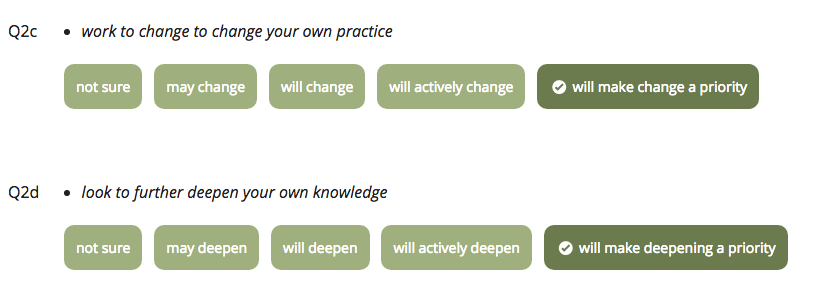
Question 2 - To what extent will you do the following as a result of the group activity?

Question 3 - Two key ideas you are taking from this activity:
My first key idea is to read further - in particular, "Healing Our History, The Challenge of
the Treaty of Waitangi" by Robert Consedine and Joanna Consedine. Accessing more
research material available on the Poutama Pounamu site will also help me make sense
of how unconscious prejudice influences and impacts on schools. I need a deeper
understanding of what has come before and the impact it has on today and how Māori
see themselves.


My second key idea is become more open to how my unconscious prejudice influences
my teaching  - what this looks like in my everyday actions and how I might make small
changes. I'm not sure what this will look like and how I will do it but I feel that reading
"Healing Our History, The Challenge of the Treaty of Waitangi" by Robert Consedine and
Joanna Consedine will provide some insight for me to make sense of this.


Question 4 - Actions I and others intend to undertake as a result:
I would like to use the material shared with us to initiate staff discussion around our
unconscious prejudices and how we bring our preconceptions without realising. In
particular the use of visual resources such as "The Choice" by Robyn Kahukiwa. I felt
this was powerful way of beginning discussions around what we see, think and wonder -
each of us has a different way of seeing what is in front of us and being able to listen to
others thinking can often add to ours. We may not agree but we are still listening to others
(hopefully!).