Sunday, October 22, 2017

Social media in professional development

If I had been asked to consider how social media can be used to support my professional development a few years ago I would have been at a loss to comment. Up until a few years ago, I stayed away from social media, almost feeling that it was an intrusion of privacy, as well as being wary of exposing myself. I now recognise that I was in the late majority in adopting social media as a means of developing professionally (Robinson, 2009). How this has changed! The changes that have taken place occurred when I undertook more study. I have been exposed to and encouraged to seek out new research and learning to support my ongoing study. Use of socially networked professional learning as I experienced in a tertiary environment enabled me to build learning relationships (Steinfield, Ellison, & Lampe, 2008; Yu, Tian, Vogel & Chi-Wai Kwok, 2010, as cited in Melhuish, 2013). Having the opportunity to connect, collaborate, support and share opened up new possibilities and pathways to explore.

What I am using
We have a strong culture of using online social platforms to make connections, push our thinking and open up new possibilities. I predominantly use Facebook (10 education groups), Twitter and VLN as networks for professional development. These are used in a variety of ways, from ‘lurking’ (reading but not commenting) to making connections, posing questions, exploring resources, participating in discussions and collaborating with others to challenge and affirm practice. The use of social media in PD is an inexpensive way to access our ever-widening community of experienced and innovative teachers, especially in our very busy times and tightening school budgets.
Challenges
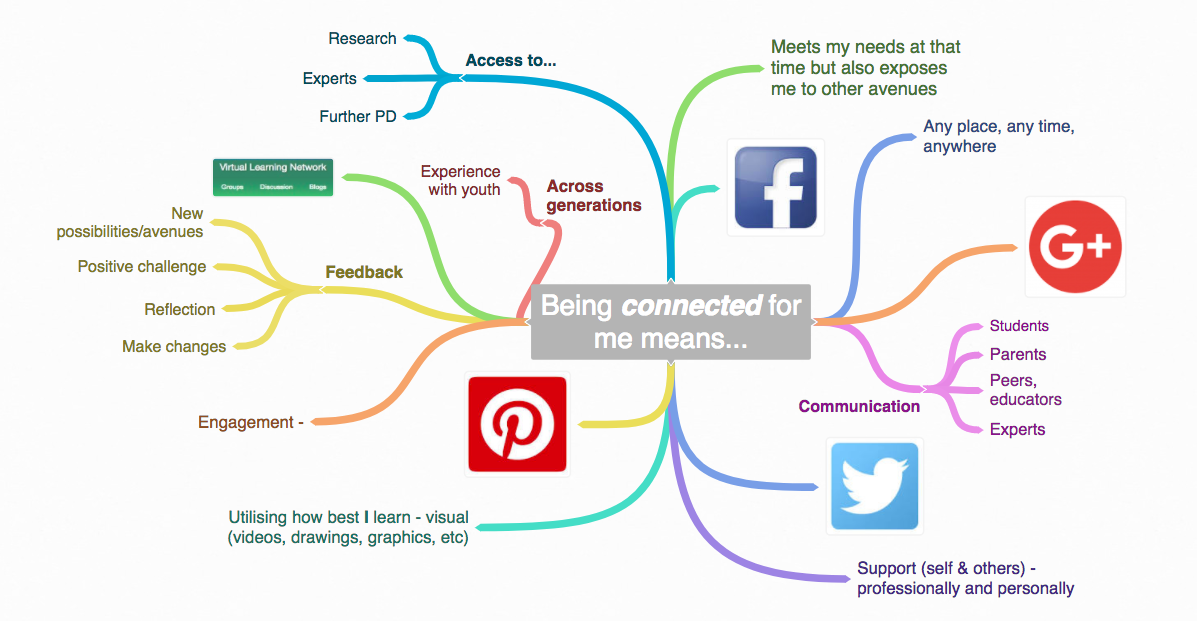
As you can see from the above Coogle, my use of social media is still quite limited. I am very aware of how the amount of content available can be overwhelming at times and that there is a need for having a clear purpose, identifying the benefits and how best these can be communicated (Connected Ed. Video, 2013). Sitting alongside this is the importance of social interaction and the need to develop relationships where you are actively engaged, both producing and consuming information/content; “prosumers” as Toffler, 1980, as cited in Kaplan & Haenlein, 2010 describes.
A challenge that arises when I use social media for my professional development is being able to critique content/practice/pedagogy - is there a research basis to what is being shared? How do I know? How do I find out more? Melhuish (2013) discusses the lack of unpacking theory and its place in practice when educators are engaging and networking, leading to the risk that ‘networking creates assimilation or affirmation of current practice without question” (p. 43).


Through my participation in further study both at Waikato University and Mindlab, I have developed social networks that I will continue to access to both challenge and refresh my pedagogy and practice. Honestly, I think my ongoing challenge is to stay an active, self-directed and self-organised learner (Schaffert & Hilzensauer, 2008) while balancing the increasing demands of teaching with family. To do this I need to critique what I access, the real purpose, who benefits and how this can be measured - there are so many ‘rabbit holes’ to disappear down!


References:

Melhuish, K. A. V. (2013). Online social networking and its impact on New Zealand educators’ professional learning (Doctoral dissertation, University of Waikato)

Office of Ed Tech. (2013, Sep 18). Connected Educators. [video file]. Retrieved from https://www.youtube.com/watch?t=216&v=K4Vd4JP_DB8

Robinson, L. (2009). A summary of diffusion of innovations. Enabling change

Kaplan, A. M., & Haenlein, M. (2010). Users of the world, unite! The challenges and opportunities of Social Media. Business horizons, 53(1), 59-68.

Schaffert, S., & Hilzensauer, W. (2008). On the way towards Personal Learning Environments: Seven crucial aspects. Elearning papers, 9, 1-10.

Tuesday, October 10, 2017

Legal & Ethical Context in my Digital Practice

In 2015 I completed the Teachers as Professionals paper at Waikato University as part of my study to upgrade to a Bachelor of Teaching. This provided an opportunity for me to look closer at legal and ethical issues and the possible impact on key stakeholders. The schools that I have worked in have all had clearly defined policy and protocol for students and staff alike so any situations I have been involved with have had a clear process to follow. As a result of exploring the Code of Ethics (Education Council, 2017), myself and another teacher have facilitated staff meetings where different scenarios were presented to promote discussion and raise awareness in our ever-changing learning environments. A particular focus was placed on device use, online accessibility and social media (staff and students).   
Hall (2001) discusses how the changing face of New Zealand (ethnic diversity and moral pluralism) and the blurring of the role of whanau with the school curriculum has impacted on the teaching profession. This has impacted on my teaching in a BYOD learning environment as I have found the use of digital devices, online access and who is ultimately responsible for what happens is becoming increasingly tricky. School policy and protocols need to be constantly reviewed and updated, using resources such as Digital Technology, Safe and responsible use in schools (2015) and Digital technology guide for schools (2017).
Ethical Dilemma

The increasing access and use of personal digital phones by younger and younger students brings it’s own ethical dilemma as the phone is a personal item that may or may not be used for learning.

Student A lives with her mother, visiting her father on the weekend. There is animosity between the parents and communication is strained. Mum was reluctant about her daughter having the latest mobile phone communicating this to the father, however, he went ahead and purchased the phone. Unknown to the mother, Student A took the phone to school. Student B got hold of the phone, entering the contact details into his phone. Outside of school hours Student B began to text Student A making a variety of lewd suggestions. Student A became upset and showed the messages to her mother. At this point, the mother contacted the school who were not aware that Student A had taken the mobile phone to school.
Stakeholders
  • Students involved
  • Teacher
  • Team leader
  • Person in charge of ICT
  • Principal
  • Parents.
Restrictions on actions
The phone was brought to school, parents/whānau/school were unaware. The incident took place outside of school hours.
Due to a custody dispute taking place (Student A) there is a concern that the incident could be used as evidence against the mother - not providing a safe environment.
The school has an extensive Cybersafety agreement that parents/whānau/students sign. This includes breaches that occur outside of school hours. Breaches are clearly outlined with an example, action and consequence. However if this agreement has not been signed off, what course of action is available?
Normal Course of Action.
  • Staff will investigate immediately by interviewing the student/s involved;
  • All relevant evidence will be saved
  • A brief report will be written.
  • Parents will be notified of the breach. A meeting may be requested;
  • In the event of serious breach, incident will be reported to appropriate agent: CYF, NZ Police, etc


Because the breach occurred out of school hours, the school would not set direct consequences. The school would discuss and follow up any consequences with the parents if mutually agreed.


Course of Action
I have found this a tricky situation as neither student signed a Cybersafety agreement, parents and school were unaware of the phone contact until after the incident. I have decided on this course of action: after a thorough investigation, there would be a meeting with the parents where the incident would be discussed, the Cybersafety agreement revisited and consequences for both students agreed upon. Communication throughout the process is imperative. This could be a loss of phone privileges at home and close monitoring of online activity on devices at school.


Comments would be greatly appreciated.


References

Hall, A. (2001). What ought I to do, all things considered? An approach to the exploration of ethical problems by teachers. Paper presented at the IIPE Conference, Brisbane. Retrieved from http://www.educationalleaders.govt.nz/Culture/Developing-leaders/What-Ought-I-to-Do-All-Things-Considered-An-Approach-to-the-Exploration-of-Ethical-Problems-by-Teachers

Thursday, October 5, 2017

Understanding indigenous knowledge and cultural responsiveness

My understanding of indigenous knowledge and cultural responsiveness:
Cultural responsiveness and inclusivity is an area our school is collectively working on to gain a better understanding of what culturally responsive practice is and what it looks like in our context. One has to define culture to unpack what indigenous  knowledge and cultural responsiveness is. Culture is about worldviews, language, values beliefs and customs that people collectively identify with. An understanding of culture sometimes only comes about when one’s own culture is made visible through exposure to the culture of another. Culture is more than an accumulation of knowledge of the content of culture. It is about appreciating different ways of being, different ways of responding and thinking. This is not something that can be gained through asking, through research but through attempting to walk in another person’s shoes. Culturally responsive pedagogy is about learning relationships - when teachers purposely weave together learners cultural knowledge, their own funds of knowledge, make connections, use a variety of teaching approaches and engage the community to build positive learner centred education. Building positive, respectful relationships between teacher, learner, whanau and wider community are paramount.
My Context
To be honest, as I grew up indigenous knowledge and culture was not something that was seen as of value and even as a young teacher struggled with this perception as it went against my personal values and belief systems. Bishop, Berryman, Cavanagh & Teddy (2009) discuss the idea of challenging deficit theorising and how building effective reciprocal relationships will help address educational disparities. As a whole school focus our journey in culturally responsive practice is in its infancy and changes are being made. We had long recognised that this was an area that required our attention but struggled to access the support and guidance we needed in order to make things happen. The kick start we desperately needed came in January this year when we attended a one day workshop led by Janelle Wiki-Waaka. The question that resonated with me was “How would I know that I was in a classroom in Aotearoa?”. Jenelle followed this up with this is the only country where the Maori language exists, and that we cannot ‘go’ anywhere else in the world to learn it. Even pronunciation of words speaks volumes about what is valued in the wider community and by extension in the school. I have found that in making my own culture explicit and that of others that I am learning a lot about my own culture that had formerly been invisible to me.
What we do well
  • High expectations of all, including each other (teachers).
  • Eliminating deficit thinking, using research to challenge preconceived ideas, making connections outside of our school environment with ‘experts’ and mentors for support and guidance.
  • Our learning environments are culturally safe (reflecting what Jenelle asks “How would I know that I was in a classroom in Aotearoa?” Beginning the day with Karakia, specific waiata to welcome visitors and acknowledge those who have returned, knowing our pepeha and sharing this. We are feeling our way as sensitively as we know how and are open to input, guidance and feedback from our Māori community.
  • Te reo (limited but growing) is woven through all we do throughout the day (correct pronunciation of names and places, greetings/farewells, commands, vocab., questions, etc). Through the development of a partnership with the local iwi, to again enable their voice to play an active part in this aspect of the school life and its ever changing role and identity in the community will support our pronunciation and using appropriate protocols.
  • Build inclusive, responsive relationships where we value what each learner brings to school in their kete - collecting student/whānau voice through interviews, surveys, etc.
  • Tuakana/teina relationship - where the roles of expert and learner can be reversed at any time (including teacher/student/whānau).
  • Recognising, valuing and accessing the cultural intelligence and knowledge our learners have (the need to ‘know’ who our learners are).
What we need to continue to work on
  • Unpacking Tātiako and critiquing our learning environments against Ako, Wānanga, Whanaungatanga, Manaakaitanga and Tangata-Whenuatanga.
  • Building strong respectful relationships with the tangata whenua.
  • Making a space for the voices of tangata whenua to be heard and for Maori aspirations to be listened to and actioned on.
With the ongoing support of CORE facilitator Marian Pearce
  • Digging deeper into what success as Maori looks like at NPS ().
  • Developing a school wide Te Reo Māori learning programme.
  • Inclusion of Te Reo and Tikanga Māori across all learning areas.
  • Develop effective whānau engagement tools.
If we are working in authentically culturally responsive ways then we seek knowledge are open to new learning and do so in ways that allow us to learn more of the what. As partners with Pakeha of the Treaty of Waitangi their position in NZ society is different I think to the position of other cultural groups and does enable them with a precedence,
On a personal level
Mindset is vital as it can be very easy to fall back into deficit theorising and search for excuses as to why Māori and Pasifika learners are not achieving as they should, implying the problem is with them. If our education system is not serving these learners well, we need to seek, identify and shift the focus. It is integral that your teacher spiral of inquiry reflects your culturally responsive and inclusive pedagogy and practice. Culturally responsive practice is sustainable, becoming something you do, not something that is ‘done’ to you.
References

Bishop, R., Berryman, M., Cavanagh, T. & Teddy, L. (2009).Te Kotahitanga: Addressing educational disparities facing Māori students in New Zealand. Teaching and Teacher Education, 25(5),734–742

Saturday, September 30, 2017

Contemporary Trend Shaping Education - Family Matters

The trend shaping education (OECD, 2016) that most resonated with me was Family Matters (pp. 19), with the following key points
  • Families are becoming reconstituted with single-parent families on the rise
  • Families are smaller or there is a conscious choice to not have children
  • Divorce rates are rising, yet marriage rates are declining
  • People are taking longer to get married
  • Our population is ageing
  • Household debt is rising
  • Impact of parental stress

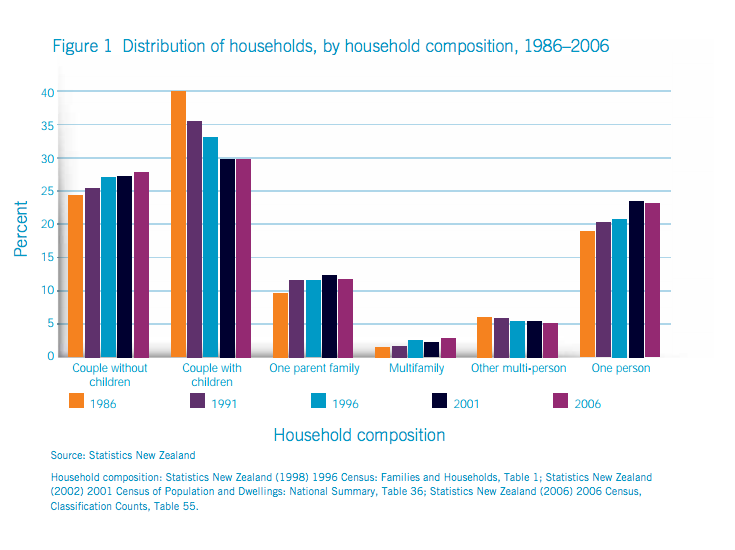
The previously dominant family type in New Zealand was the nuclear unit with a husband, wife, and children. There is now a diverse range of family types in NZ as shown by the New Zealand Families Today (July 2013, p. 3):

Screen Shot 2017-10-01 at 4.30.48 PM.png

How does this impact our education system?
I have chosen this trend as it directly impacts the education system. Families are the initial role model when it comes to values, culture, and traditions which in turn shape behaviour. It is important that we are inclusive and responsive to the growing demands within the family unit - be it grandparents raising grandchildren (9543 grandparents in a parental role - 2013 Census), or joint custody arrangements where time is shared between both parents. As more pressure is placed on families to meet their household demands (housing, nutrition, health, etc) there is also growing stress and mental health needs that impact on the education system through the children who are attending school. Children will struggle to learn and achieve if support is not available. However, conflict and frustration can arise as the rights and responsibilities of parents and schools becomes increasingly blurred as schools feel they are being expected to take on more responsibilities and the curriculum becomes more crowded. For example, “The case for teaching kids how to drive”. Schools are being asked to provide more but without the funding that supports this.

What does this mean for teaching practice?
We as teachers need to understand the nature and function of our families in order to make changes to our practice. We have noted that our changing family structures demand more inclusivity and responsiveness and PLD has been organised in response.  For example, Nathan Mikaere-Wallis. He discusses the importance of the family/environment and how we as teachers need to understand the impact of family dynamics so we are able to fully engage our children in learning and success. An extra effort needs to be made by schools in order to engage learners, family, and whānau so that positive trusting relationships are formed and partnerships built on with shared aspirations for children and learning. Through promoting acceptance of the many differing family structures we model tolerance and diversity so that all are included. Within our school, careful consideration is given to how we promote ‘Mother’s Day”, Father’s Day” etc so that children do not feel marginalised or excluded.

Consideration needs to be given to how best we can support families, especially those who are disadvantaged, without passing judgment or creating a feeling of intrusion - a tricky skill to master! However, by building positive, trusting relationships, open lines of communication can be initiated and grown and additional support discretely given. This, in particular, is an area that our school has continued to focus on as family structures and needs change within our community - parent/whanau engagement to support student learning and well-being, meeting the future needs of our society.


References:

OECD. (2016) Trends Shaping Education 2016. OECD Publishing, Paris. DOI: http://dx.doi.org/10.1787/trends_edu-2016-en

Statistics New Zealand (04 November 2014). Retrieved from
http://www.stats.govt.nz/Census/2013-census/profile-and-summary-reports/qstats-families-households/grandparents.aspx

Saturday, September 23, 2017

My Professional Context - Current Issues

Who we are?
Our school, located in the main service town on the Hauraki Plains is a full primary (Years 0-8), English medium school currently funded as a Decile 6 school. Our current roll is 299 students including 50 students who identify as Maori, 7 Pasifika and 5 Asian. As a school we have strived to raise levels of engagement and achievement, primarily through our 1 - 1 digital learning programme (BYOD) which was introduced in 2012, initially to Year 7 & 8, then expanded to include Years 4 - 6. This was the first of its kind on the Hauraki Plains.

What is the impact?
The consistent decile ranking of 6 has impacted on our school in a variety of ways. Staff and BoT use school-wide entry data, assessment data and current research available to help identify trends within the school and how best these can be resourced. The impact of lower socioeconomic status on educational achievement is well documented (APA, 2016; UNICEF, 2016; Snook & O’Neill, 2014; Thrupp, 2014) where what the child ‘brings to school’ is heavily influenced by their health, home environment, resources available and parent stress. Partly due to our Decile ranking of 6 and our minor urban area we have limited access to MoE schemes or initiatives that would support our student's educational achievement (E.g Fruit in schools), targeted funding for professional development and other support programmes in the school such as Sanitarium Breakfast Club and Eat my Lunch. The school’s BoT identifies this as a priority within the school and funds ongoing professional learning programmes for staff, additional learning support in-class and discretionary funds for those who need support. There is a strong focus on building a school culture and learning environment that is both responsive and inclusive. As part of the ongoing professional development, the school is enthusiastic about investigating further, the work of Nathan Mikaere-Wallace.

NPS School Culture
The first impressions of a school can heavily influence any prospective parents/whanau choice in where they choose to enrol their children. This is known as the school culture - not only the values and beliefs of that school but how they act and react in different situations. Stoll (1998) refers to culture as “situationally unique” and what may work in one school may not necessarily work well in another school. The school needs to be clear in its reason for being, what sets it apart and where it is heading.

Ngatea Primary School (NPS) is very aware and mindful of the impact culture has. We constantly revisit what it is to be part of NPS; our values and goals, how we can achieve more (professional development, student outcomes, engagement with our community and beyond), support to take risks, the why and where to next. All of which are included in what Stoll and Fink (cited in Stoll, 1998) identify as cultural norms that influence school improvement.
An area that staff have identified as needing more focus is celebration, at times we are so intent on the next steps that we neglect celebrating what we (teachers and students) have achieved!

All of the above are built on the positive and meaningful relationships we have with each other as teachers, with our students and whanau and the wider community. If these are strained or lacking the result is mixed messages and a feeling of ‘going through the motions’.

References:
Snook, I. & O’Neill, J. (2014). Poverty and inequality of educational achievement. In Carpenter, V., Osborne, S. (Eds.), Twelve thousand hours: Education and poverty in Aotearoa New Zealand (pp. 19-43).  Auckland, New Zealand: Dunmore Publishing.
Stoll. (1998). School Culture. School Improvement Network’s Bulletin 9. Institute of Education, University of London. Retrieved from http://www.educationalleaders.govt.nz/Culture/Understanding-school-cultures/School-Culture
Thupp, M. (2014). Deficit thinking and the politics of blame. In Carpenter, V., Osborne, S. (Eds.), Twelve thousand hours: Education and poverty in Aotearoa New Zealand (pp. 88-101).  Auckland, New Zealand: Dunmore Publishing.
UNICEF. (2016). Child poverty in New Zealand. Retrieved from

https://www.unicef.org.nz/learn/our-work-in-new-zealand/Child-Poverty-in-New-Zealand

Saturday, September 16, 2017

My Community of Practice

Whenua Teaching Team

I am part of the dynamic duo who teach and learn in an ILE/MLE where we consider ourselves ‘Authors of our own learning - in a collaborative and supportive community that lets play, passion and purpose grow’. Our Whenua learning team is made up of two teachers, 56 learners, and two learning support ladies. My role as team leader provides opportunities for me to not only lead but follow where the strengths of those whom I work with are built upon and shared with others. There is a strong culture of support and sharing of ideas, reading and research within our team. Opfer & Pedder, 2011) refer to this as a micro-learning community of practice that is achieved through an open modern learning environment.

School Community

Over the last 7 years we as a school have been on a journey where we have constantly critiqued, questioned and researched what we as teachers are doing for our learners. “What is collaboration and how do we learn together?” “What’s going on for our learners?” “How do we know?” “Why does it matter?”. This enables us as a staff to inquire into the latest research and published material, focusing on what may be beneficial for our school (staff, students and whanau). Within our school there are people (teaching staff, support and administrative) who have areas of expertise or passion who also mentor and support ongoing reflection and change. Our deputy Principal has led the school through a rigorous self reflection process with a focus on Dumont, Istance & Benavides ‘The Nature of Learning - using research to inspire practice’ (2010) and Timperley, Kaser & Halbert “A framework for transforming learning in schools: Innovation and the spiral of inquiry (2014) as a framework to lead change. Our BOT provides the financial assistance and investment to enable us to stay current in research.


Kāhui Ako - Hauraki CoL

We belong to the Hauraki CoL where information/data is shared and achievement challenges are shaped in response to the baseline data collected. These include surveys (NZCER Teaching and Leadership Practices Survey, NZCER Me and My School Survey) and student assessment data (e-asTTle, PAT). There has been a focus on improving practice with particular attention paid to writing outcomes. Support and guidance are provided by outside agencies to develop a shared understanding of effectiveness capabilities, current learning and teaching practices and engaging community.


Virtual Communities
There has been a rapid increase in accessing and using online tools and communities to broaden my teaching knowledge and practice. I belong a variety of online communities such as Facebook (e.g. NZ Primary Educators PLN, NZ Teachers (Primary), Te Reo Maori (Mainstream NZ Primary) to name a few. Google+ communities include Mindlab, Hauraki CoL as well as VLN, Twitter and LinkedIn. All of these provide a platform for discussion, critical reflection, support and research that can be utilised in my learning environment to best meet the needs of myself as an educator and my students. I am able to access people and resources I have not been able to do previously - a truly global community of practice.


References:
Dumont, H., Istance, B., & Benavides, F. (2012). The nature of learning. Using Research to Inspire Practice. Practitioner Guide from the Innovative Learning Environments Project. OECD. Zugriff 7, 2014.


Opfer, V., & Pedder, D. (2011). Conceptualising teacher professional learning. Review of Educational Research, 81(3), 376-407.

Timperley, H., Kaser, L., and Halbert, J. (2014, April). A framework for transforming learning in schools: Innovation and the spiral of inquiry. Centre for Strategic Education, Seminar Series Paper No. 234.

Friday, April 28, 2017

It's been a long time between posts!

A lot has happened since 2015 when I last posted. I was lucky enough to have been awarded a year's study leave to complete my Bachelor of Teaching at Waikato University.  It was with much trepidation that I embarked on that journey as my experiences at uni were not that enjoyable the first time around (try the late 80s). My fears were unjustified this time around - I met an amazing group of student teachers completing their third year at uni who helped and encouraged me along the way. The connections made added to my overall experience and the schools that have employed these enthusiastic young people should be very pleased with themselves.

I loved learning - the readings, discussions and even the odd assignment!

Suffice to say, I completed my papers and graduated in November 2016!